
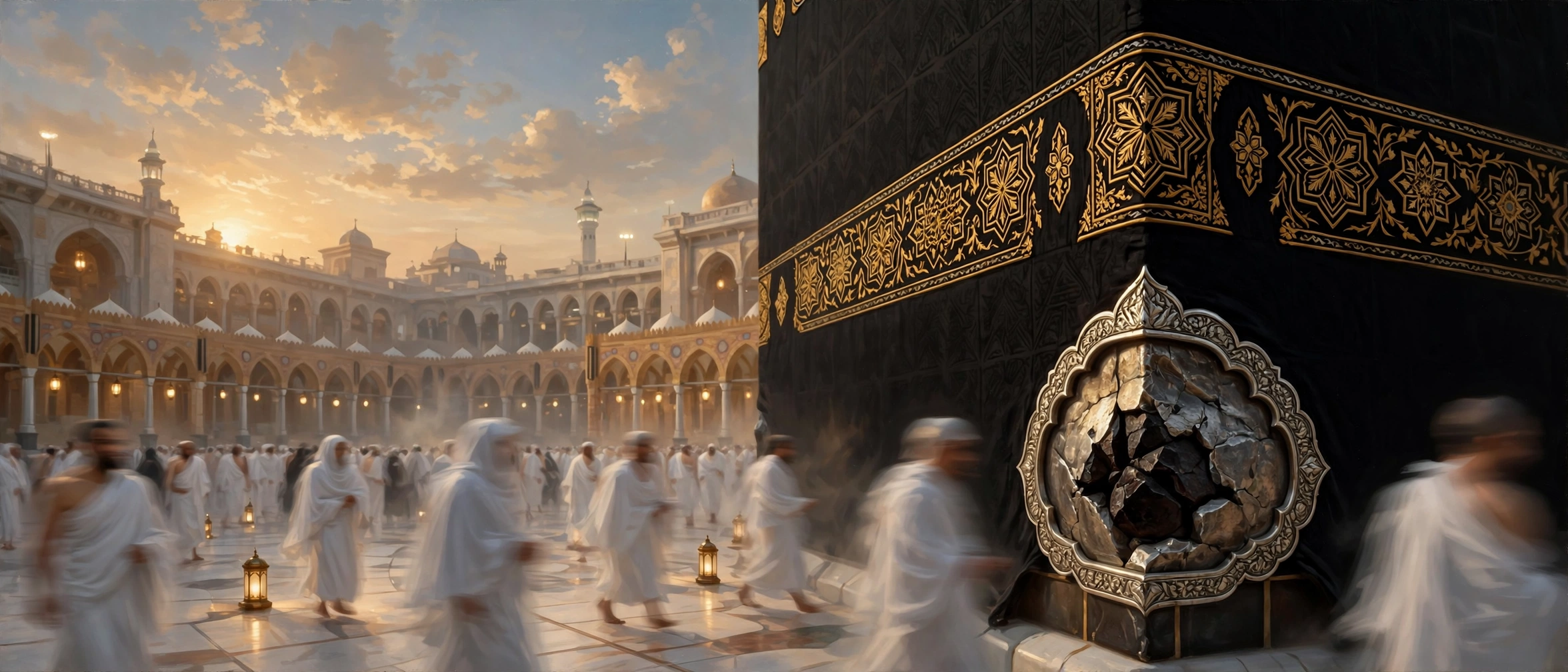

The Black Stone: Why Is Kissing a Sacred Stone an Islamic Ritual?
Every year, millions of Muslims travel to Mecca for Hajj and Umrah. During the pilgrimage, many attempt to kiss, touch, or gesture toward a particular stone embedded in the eastern corner of the Kaaba: al-Hajar al-Aswad, the Black Stone. Mainstream jurisprudence calls kissing it a recommended act of worship.
But every Muslim who takes the Quran as the authority for religious practice should ask one question: where does Allah instruct us to kiss, touch, or salute the Black Stone?
This is not an accusation that Muslims worship the stone. Mainstream Muslims overwhelmingly reject that characterization. They say kissing it expresses obedience to the Prophet, not worship of the object. That distinction deserves to be acknowledged.
The question runs deeper: what Quranic authority exists for turning physical contact with a particular stone into a religiously meritorious act?
1. The Quran never mentions the Black Stone
Not by name, not by description. It does not instruct believers to kiss it, touch it, or gesture toward it. It associates no forgiveness, blessing, or reward with contact.
This silence matters because the Quran is not silent about the pilgrimage. It explicitly recognizes circumambulation of the Kaaba (2:125), commands Abraham to proclaim the pilgrimage (22:27-29), and identifies Safa and Marwah as symbols of Allah (2:158).
Circumambulating the Sacred House has explicit Quranic grounding. Kissing the Black Stone does not. The two should not be treated as possessing the same scriptural authority.
2. The Quran describes itself as complete and detailed
“Should I seek a judge other than Allah while He is the One Who has revealed to you the Book perfectly explained?” (6:114)
“And We have sent down to you the Book as clarification for all things.” (16:89)
Ordinary actions need no verse. But when an act is presented as pleasing to Allah and spiritually rewarded, someone is making a claim about religion, and claims about religion require authority. If touching this stone is an act of devotion that earns reward, who assigned it that status, and where is the evidence in His Book?
3. The justification comes from hadith, not the Quran
The most cited report (Sahih al-Bukhari 1597) has Umar ibn al-Khattab kissing the stone while acknowledging it can neither benefit nor harm him, explaining he does so only because he saw the Prophet do it.
Even accepting the report, questions remain: was it religious instruction for all future Muslims, a personal gesture, or a local custom? The hadith does not establish a Quranic command. Traditional jurisprudence treats the reported action itself as sufficient grounds for recommendation. That is precisely the point of disagreement.
4. Honoring sacred places is not the same as sacralizing objects within them
“And whoever honors the symbols of Allah, indeed, it is from the piety of hearts.” (22:32) But the symbols must be Allah’s symbols, designated by Him. He designated the Sacred House, Safa and Marwah. Where did He designate the Black Stone as an object to be kissed?
Facing the Kaaba in prayer has explicit authorization (2:144). Kissing the Black Stone has none. Religious significance cannot simply be transferred from a divinely designated place to every object associated with it, or where would it end? Touching the walls? Rubbing the doors? Traditional scholars themselves draw lines here, which proves the point: once we leave the Quran’s explicit guidance, some other authority must decide which gestures count as worship.
5. The Quran warns against unauthorized religious legislation
“Or have they partners who have ordained for them a religion which Allah has not authorized?” (42:21)
Sincere intentions do not establish a practice’s legitimacy. If religious authorities teach that kissing the stone is a recommended act of worship deserving reward, they are assigning religious merit to an action. What gives anyone that authority without a Quranic basis?
6. “We do it because the Prophet did it” deserves a serious answer
The Quran commands obedience to the Messenger. The dispute is how that authority is preserved. “I only follow what is revealed to me.” (6:50)
Suppose Muhammad touched a particular tree or drank from a particular vessel. Would reproducing those acts be religiously meritorious? Traditional scholarship itself distinguishes ordinary prophetic behavior from religious instruction. A reported action is not necessarily a divine command.
Conclusion: Who decides what counts as worship?
The Quran commands pilgrimage, recognizes the Sacred House, and instructs circumambulation. It does not tell us to kiss the Black Stone. That recommendation comes from hadith literature and the traditions built on it.
This is not an argument against Hajj, nor an accusation of idolatry. It is an argument for taking the Quran’s authority seriously. If Allah gave us a complete and detailed Book, should we regard kissing the Black Stone as meritorious because Allah instructed us, or because generations accepted a practice the Quran never prescribes?

Ibrahim Hammoud is a Michigan trial lawyer who has recovered over $40 million for his clients and the author of Winning Before You Walk In. He also writes Rightly Guided Teacher, on a mission to expose the hadiths used by all sects that try to contradict the clear message of Allah swt in the Quran.
Leave a Reply